Projets de semestre
Current projects recruiting at Sailowtech are dedicated to prototyping low-tech oceanographic and lake measurement tools. By carrying out a project credited to Sailowtech, you automatically become a member of the association, and can take part in expeditions and other events!
If you are interested in a project, please contact us at vp.science@sailowtech.ch .
Available projects - Autumn 2026
CREDITED - Electronics & PCB for the Sailowtech CTD
The redesign of the Sailowtech CTD (Conductivity, Temperature, Depth) electronic hardware strives for an optimal balance between low power consumption, structural robustness, and reliability under severe marine environments. Designed to operate autonomously during long sailboat expeditions, the device must transit away from high-power single-board computers to highly efficient embedded platforms. The objective of the project is now the following: Evaluate and select a new low-power microcontroller control platform with native wireless capabilities to ensure a future connected mode with the Sailowtech weather station, complete the full hardware redesign of both the power management/BMS battery PCB stack and the main sensor controller PCB, and minimize the overall footprint to fit perfectly inside a compact enclosure.
Project description -> HERE <-
A credited project in partnership with the SenseLab in Sion.
Recommended sections: EL, Robotics, Microengineering, GM, MX…
CREDITED - Firmware & Software for the Sailowtech CTD
The development of the Sailowtech CTD (Conductivity, Temperature, Depth) core software infrastructure strives for absolute architectural robustness, optimal energy management, and intuitive user operation for field deployments. To successfully move past legacy Python scripts running on power-hungry hardware, the new embedded firmware must be engineered from scratch around modern low-power real-time constraints. The objective of the project is now the following: Rewrite the entire data acquisition firmware in C/C++ or MicroPython for the new microcontroller platform, develop reliable backend drivers for hardware sensors handling complex calibration routines, timeouts, and data quality checks, implement adaptive sampling rules for thermal gradients, and build an intuitive, polished web-based frontend UI featuring dedicated modules for sensor calibration, metadata entry, and real-time data visualization.
Project description -> HERE <-
A credited project in partnership with the SenseLab in Sion.
Recommended sections: Informatics, EL, NX, Robotics, Microengineering, GM, MX…
CREDITED - Develop a robotic under-water vehicle (Argo-Float)
The development of the Argo-Float project aims to provide a compact, autonomous, and adaptable platform for environmental monitoring in lakes and other aquatic environments. Inspired by Argo profiling floats used in oceanography, the system performs repeated vertical “yo-yo” movements to collect data throughout the water column while remaining low-cost, modular, and energy efficient.
The project focuses on the integration and testing of multiple sensing and communication systems, with the objective of improving the float’s autonomy, reliability, and scientific capabilities. Current areas of development include adaptive sampling strategies based on lake conditions, wireless transmission of collected data to nearby ships, and interfacing with additional environmental sensors such as CTDs. Another important objective is the development of an under-ice deployment configuration using a submerged anchoring system instead of a surface buoy, enabling measurements in lakes, fjords, and polar environments. Future work also includes hardware and electronics redesigns to transition from prototyping solutions toward a more robust and professional platform.
Project description -> SOON <-
This project corresponds to approximately 10 credits and is in partnership with the SENSE Lab and EAWAG.
Recommended sections: Robotics, NX, EL, MT, GM…
NON CREDITED - Improve our Low-Tech Weather Station
The development of the Sailowtech weather station project aims to provide a compact, modular, and open-source environmental monitoring platform adapted to the constraints of scientific sailing expeditions. Designed for deployment aboard small sailboats, the station combines atmospheric sensing, onboard data logging, wireless communication, and computer vision in order to collect high-quality environmental data in real conditions. The system measures air quality, meteorological variables, solar irradiance, and cloud coverage, while also interfacing with external instruments such as CTD probes and the boat’s NMEA 2000 network.
A fully functional prototype has already been designed, assembled, and validated through laboratory and field testing. The current objective of the project is to improve the robustness, scalability, and long-term deployability of the platform before wider replication within the Sailowtech ecosystem. This includes refining the mechanical enclosure for harsh marine environments, optimizing power management and communication protocols, and extending the modular sensor architecture to support additional instruments. Particular emphasis is placed on maintaining a low-cost and open-source philosophy, allowing future teams and citizen-science initiatives to reproduce, modify, and expand the platform for distributed environmental monitoring campaigns.
Project description -> SOON <-
Recommended sections: Energy, MT, EL, Robotics, NX, GM…
NON CREDITED - Create the Sailowtech Database
The implementation of the Sailowtech centralized data pipeline strives for a reliable, structured, and easily accessible storage framework for open-source environmental data gathered across multiple oceanic and lake expeditions. Designed to host heterogeneous field telemetry—spanning atmospheric pollutants, marine water characteristics (CTD data), and weather patterns—this infrastructure represents a core link in making frugal science participative and reproducible. The objective of the project is now the following: Complete the design and deployment of a robust database architecture capable of storing, formatting, and indexing time-series sensor logs, build data ingestion interfaces to handle messy CSV files and raw instrument text frames, and optimize backend query latency to prepare for future public API integration and data visualization dashboards.
Recommended sections: Data Science, Computer Science, Communication Systems, SIE…
Available credited projects - Spring 2026
Prototype a Dissolved CO2 Measurement Station
The open SeaO2 is a device for measuring the flow of CO2 between the atmosphere and the ocean. It has been designed in the low-tech philosophy, i.e. to be open-source, sustainable, useful and low-cost.
The aim of this semester’s project is to redesign the work of Alexandre Tellier, who designed the device at Sailowtech and Yanis Mouzaoui, who did his semester project on it last semester. One should restore the original prototype, improve its reliability and compute some laboratory test.
The Open Sea02 tool contains one equilibrium chamber with two pumps, one that pumps water inside the chamber, the other pumps the water out of chamber. There is also an air pump that transfers air to a NDIR sensor that measures C02 levels where we can deduce it partial pressure. A ToF sensor is used to maintain the water level in the chamber constant, and two microcontrollers are used to operate the pumps
Project description -> HERE <-
This project corresponds to approximately 8 credits and is in partnership with the Sense Lab in Sion. The lab pays the transport fees.
Recommended sections: SIE, SV…
Statistical Analysis of plankton in Swiss lakes (with help of the Planktoscope)
The Planktoscope is an open-source microscope for observing and identifying plankton kept in water samples. Sailowtech collected plankton samples from Lake Geneva and several other Swiss lakes, at different depths in the water column.
The Planktoscope will be used to image the organisms. The software associated with the Planktoscope allows the images to be segmented to isolate each plankton, and the EcoTaxa platform then takes care of their taxonomic identification. If all the metadata from the sampling is recorded correctly, it becomes possible to estimate the density of a given species in the sampled area.
The ultimate goal is to analyze statistics on the vertical distribution of plankton, i.e., to understand how different species are distributed according to depth.
This project involves the analysis of plankton from Swiss lakes.
Project description -> HERE <-
Recommended sections: Bachelor project of SV,SIE…
Example of plankton images obtained :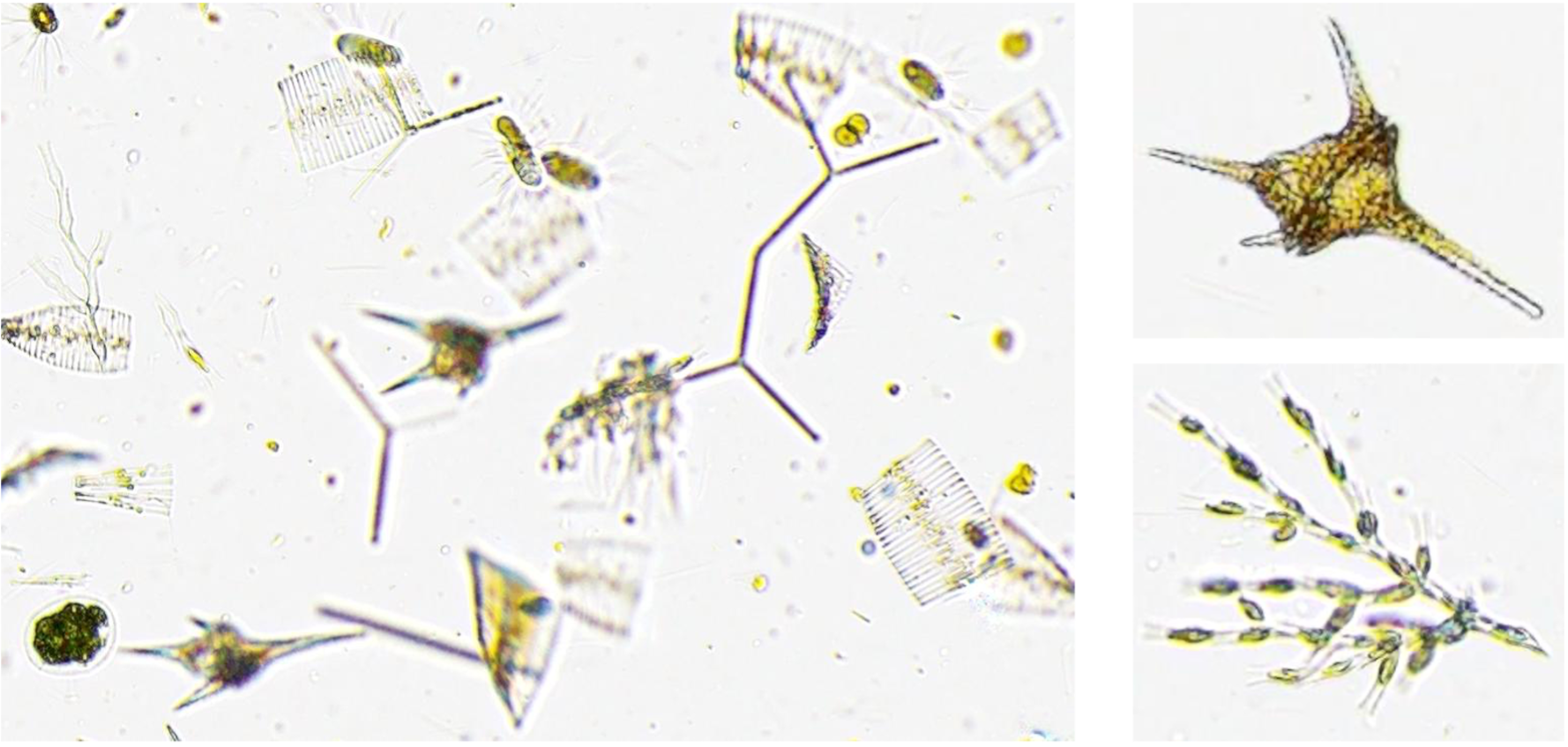
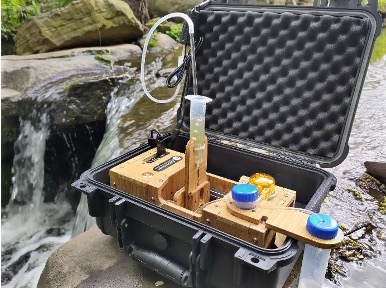
The Planktoscope that will be used:
Improve our Low-Tech Raman spectrometer for microplastics analysis
Raman spectroscopy – which analyses the light scattered by a laser beam on a sample – is a technique that can be used to identify plastics, as each plastic has a unique optical fingerprint. Furthermore, when coupled to a microscope, plastics down to < 1 μm in diameter can be studied. However, most commercial Ramanmicroscopes are bulky, expensive pieces of equipment not fit for use on a boat. The aim of this project is to perfect a low cost, small Raman microscope that can be used on a Sailowtech cruise and that identifies microplastics in samples. Several examples of low cost Raman systems exist in literature, though these have not been adapted for use on boats.
A first prototype of the Raman technology was achieved previously. A database (OpenRamanDatabase) was developed.
However, challenges remain.
Project description -> HERE <-
This project corresponds to approximately 10 credits and is in partnership with the LNET laboratory.
Recommended sections: GM, PH, MT, Robotics, MX…
Improve our Low-Tech Gas Monitoring Station
The development of the gas monitoring station strives for a successful balance between affordability, functionality, and sustainability in the context of marine environmental monitoring. Designed to operate under the constraints of sailboat expeditions, the station aims to offer a compact, low-cost, and repairable solution for tracking key atmospheric pollutants—ozone (O3), carbon monoxide (CO), and particulate matter (PM)—along with solar irradiance. It also features humidity, temperature and pressure sensors to help fine tune and calibrate the gas sensors. The objective of the project is now the following: Complete the design, integration, and testing of a multi-sensor gas monitoring station. In particular, the project aims to address key areas of improvement identified during initial development phases, including mechanical sealing, electrical redesigns, software enhancements, and user access optimization.
Project description -> HERE <-
This project corresponds to approximately 10 credits.
Recommended sections: SIE, Energy, PH, MT, EL, Robotics, GM…
Statistical analysis on our CTD
The CTD probe is a tool developed by Sailowtech, a MAKE association at EPFL that collects and analyzes lake data using low-tech methods. The CTD is a submerged instrument that measures pH, temperature, dissolved oxygen, and depth. Collecting this type of data is extremely important, particularly for establishing links between physical phenomena (temperature, water acidity) and their impact on marine biodiversity, such as plankton.
Project description -> HERE <-
This project corresponds to approximately 6 credits.
Recommended sections: SV
Available credited projects - Fall 2025
Improve our Low-Tech Raman spectrometer for microplastics analysis
Raman spectroscopy – which analyses the light scattered by a laser beam on a sample – is a technique that can be used to identify plastics, as each plastic has a unique optical fingerprint. Furthermore, when coupled to a microscope, plastics down to < 1 μm in diameter can be studied. However, most commercial Ramanmicroscopes are bulky, expensive pieces of equipment not fit for use on a boat. The aim of this project is to perfect a low cost, small Raman microscope that can be used on a Sailowtech cruise and that identifies microplastics in samples. Several examples of low cost Raman systems exist in literature, though these have not been adapted for use on boats.
A first prototype of the Raman technology was achieved last semester. A database (OpenRamanDatabase) was developed.
However, challenges remain.
Project description -> HERE <-
This project corresponds to approximately 10 credits and is in partnership with the LNET laboratory.
Recommended sections: PH, MT, Robotics, GM, MX…
Improve our Multi-Function Pedalboard
This project aims to improve a multi-function pedal system that can be adapted for various uses beyond its current blender setup. The challenges include increasing the applied force through mechanical amplification, designing the pedal mechanism so it can be easily reconfigured for different functions, and connecting it to an energy storage system (e.g., a battery) for later use. The goal is to create a versatile, user-friendly, and sustainable pedal-powered tool.
Project description -> HERE <-
This project corresponds to approximately 4 credits.
Recommended sections: SIE, GC
Improve our Low-Tech Gas Monitoring Station
The development of the gas monitoring station strives for a successful balance between affordability, functionality, and sustainability in the context of marine environmental monitoring. Designed to operate under the constraints of sailboat expeditions, the station aims to offer a compact, low-cost, and repairable solution for tracking key atmospheric pollutants—ozone (O3), carbon monoxide (CO), and particulate matter (PM)—along with solar irradiance. It also features humidity, temperature and pressure sensors to help fine tune and calibrate the gas sensors. The objective of the project is now the following: Complete the design, integration, and testing of a multi-sensor gas monitoring station. In particular, the project aims to address key areas of improvement identified during initial development phases, including mechanical sealing, electrical redesigns, software enhancements, and user access optimization.
Project description -> HERE <-
This project corresponds to approximately 10 credits.
Recommended sections: SIE, Energy, PH, MT, EL, Robotics, GM…
Available non-credited projects - Fall 2025
Open source our CTD
— Coming soon —
An uncredited project in partnership with the SenseLab in Sion.
Repair our submarine camera 'Kosmos'
— Coming soon —
It’s an uncredited project.
Improve the open-source Planktoscope microscope and analyze images.
Le Planktoscope est un microscope modulaire open-source imaginé par Fairscope. Après avoir constuit notre V1, nous souhaitons passer à une V2 de notre outil pour en améliorer sa qualité et son accessibilité.
Cet outil permet d’obtenir des images quantitatives de planctons. Une base de données open-source EcoTaxa permet de répertorier et identifier les espèces observées. Ce projet consiste à fabriquer la V2 de notre planktoscope mais aussi à le tester sur le Léman et à s’approprier la base de données. Le projet peut être adapté pour être crédités de 4 à 10 crédits. Ce projet est en collaboration avec le laboratoire d’imagerie bio-médicale de l’EPFL.
Project description -> HERE <-
Recommended sections: SV,SIE…
Images obtenues de planctons du Léman avec un Planktoscope :


